

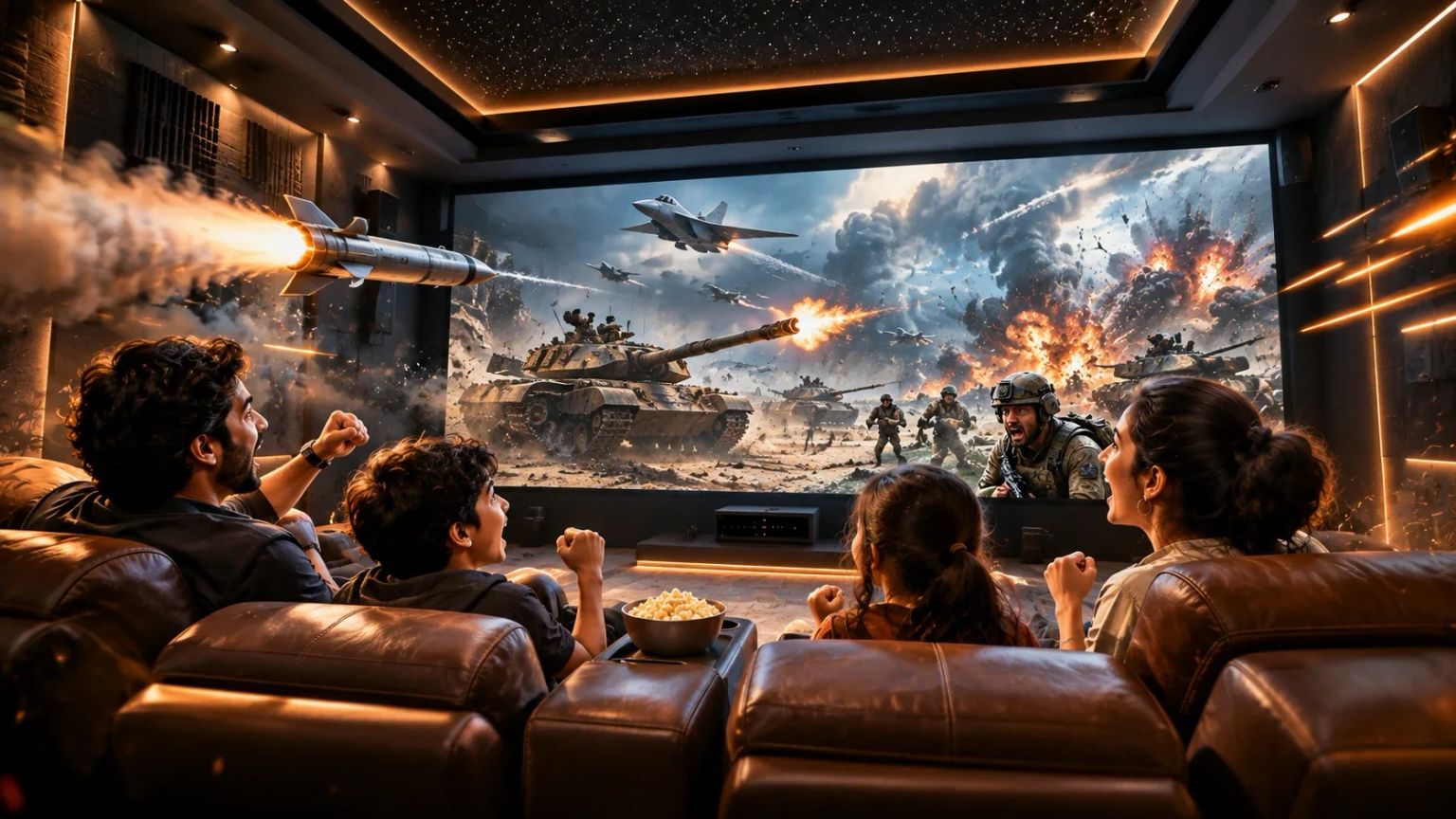
A family in leather recliners cheering at a war film on a very large cinema screen, with a missile flying out of the picture

Don’t Just Watch the Scene. Be in the Scene.

Feel every explosion, the rush of fighter jets and every moment as if you’re right in the heart of the battlefield.

Vinayak Nagar, Gachibowli · +91 93557 83557

Two formats, one method (01)

Pick the cinema that fits your room.

Smaller rooms suit 7.1.2 or 7.1.4. A full 7.2.4 is our most-requested format, and 9.2.6 is for a reference screening room. Sharing the room with the family? See living room entertainment.

7.1.2 · 7.1.4 · 7.2.4

Dedicated private cinema

About 15 × 20 ft · About ₹8–19 L

SpeakersLeft, center and right behind the screen, four surrounds, four overhead (7.2.4) and two subwoofers
Processing11-channel processing with room correction
Picture120–135" acoustically transparent screen, native 4K projector
SeatingTwo rows of motorized recliners, second row on a 12–18" riser
AcousticsTarget reverberation time about 0.3 s, corner bass traps, rear-wall diffusion

9.2.6

Reference screening room

About 18 × 28 ft · From about ₹15 L

SpeakersLeft, center and right, front wides, four surrounds, six overhead and two or more subwoofers
ProcessingSeparate processor and multichannel power amplification
Picture150"+ screen, JVC D-ILA or 4K laser projection
SeatingThree tiers of custom motorized recliners
AcousticsRoom-in-room isolation, acoustic doors, quiet air conditioning

Indicative guides. The final quote follows a site or blueprint review. Try the cost estimator, or read which Atmos format to choose.

The room decides how it sounds (02)

The equipment is the easy part.

Tile, marble and RCC walls reflect sound hard, smearing dialogue and making bass boomy. We aim for a controlled reverberation time of about 0.25–0.4 seconds, with fabric panels, corner bass traps and rear-wall diffusers hidden inside your interior finishes.

To keep sound in, we use decoupled walls, ceiling isolation, solid doors with drop seals and quiet air conditioning, so the cinema does not wake the house.

Details on the acoustics and calibration, projectors and screens and theater seating.

How we build it (03)

Drafted before it is built, tuned after.

Every room is planned on paper first, so your builder never chisels finished walls.

01

Plan

Speaker angles, sightlines, riser heights and conduit routes are drawn before plastering, from your floor plan and ceiling height.

Floor plan · Ceiling height

02

Build

Acoustic treatment, wiring, screen, projector, speakers and seating go in with your interior team, hidden behind fabric, timber slats or feature walls.

With your interiors

03

Calibrate

Microphone measurement at every seat, subwoofer alignment, DSP room correction, a listening check with reference scenes, and 4K picture calibration.

Measured, not guessed

Planning a build? Read the pre-plastering wiring checklist and the room size, ceiling height and seating guide.

Walkthroughs (05)

Hear what a client says, then see the room.

A client review of a dedicated theatre we installed. More rooms are on our @AVBOXINDIA YouTube channel.

CLIENT REVIEW · DEDICATED THEATRE@AVBOXINDIA
Questions (06)

FAQ · Straight answers

Questions homeowners ask us

01 What is a dedicated home theater?

It is a room built only for watching films: controlled light, treated acoustics, a projector and screen, and seating placed for the best sound and picture. Compared with a living room system, it can be darker, quieter and louder without disturbing the rest of the house.

02 How much does a dedicated home theater cost?

As an indicative guide, a dedicated 7.1.2, 7.1.4 or 7.2.4 private cinema with acoustic treatment costs about ₹8–19 lakhs, and a 9.2.6 reference screening room with recliners and isolation starts around ₹15 lakhs and can exceed ₹30 lakhs. The final quote follows a site or blueprint review.

03 How big should the room be?

A 7.2.4 cinema is typically planned around 15 × 20 ft, and a 9.2.6 reference room around 18 × 28 ft. Ceiling height matters as much as floor area, because overhead speakers and the screen need room. Our room-size guide explains how we plan it.

04 Do I need acoustic treatment?

Yes. Tile, marble, glass and RCC walls reflect sound and blur dialogue. We aim for a controlled reverberation time of about 0.25–0.4 seconds, using fabric panels, bass traps and diffusers that can be disguised as part of the interior.

05 How long does it take to build?

It depends on the room and on construction. One 7.1.4 theatre of ours was completed in 8 days, and you can see it in its walkthrough. A new room built with the house takes longer, because wiring, ceilings and acoustics are planned together.

06 Can I convert an existing room?

Often yes. Send us the floor plan and ceiling height and we will say what is realistic. If walls and ceilings are still unplastered, planning the conduits first avoids chiselling later.

Ask the AV Box team · Vinayak Nagar, Gachibowli

Bring your floor plan. We will tell you what is realistic.

Experience Dolby Atmos, Zigbee lighting scenes and Ajax security in a working room at our Gachibowli Experience Center — then take home a measured, itemised proposal.

Book a DEMO now WhatsApp